

Montessori and EYFS
Our highly esteemed educators and practitioners possess formal qualifications or are in the process of obtaining either a Montessori Degree or a Degree of NVQ Level 3 in Early Childhood Education. Additionally, they undergo training in the Montessori Principles.
Montessori is a comprehensive educational approach from birth to adulthood based on the observations of children's needs in a variety of cultures.
Maria Montessori was born in 1870 in Ancona, Italy. She studied engineering and mathematics then went on to qualify as the first female doctor in her country’s history. In 1907 she opened her first school, in the area of San Lorenzo. She was so encouraged by her results that she began to share her discoveries with others by publishing books and lecturing. Thus, the Montessori Method of education was born.
The Montessori environment contains specially designed, manipulative "materials for development" that invite children to engage in learning activities of their own individual choice. Under the guidance of a trained teacher, children in a Montessori classroom learn by making discoveries with the materials, cultivating concentration, motivation, self-discipline, and a love of learning.
Montessori materials are unique, beautiful, mainly wooden and carefully crafted by experts. We aim to introduce the child to Practical Life skills using a wide range of materials especially designed to develop the child’s dexterity and muscle control. This prepares the child not only for writing at a later stage but answers his pleas for ‘help me to do it myself’, thus encouraging further independence and confidence.
We help the children with their gross and fine motor skills via the Montessori Sensorial apparatus. The children participate in group discussions and become able to express themselves using a wide vocabulary.
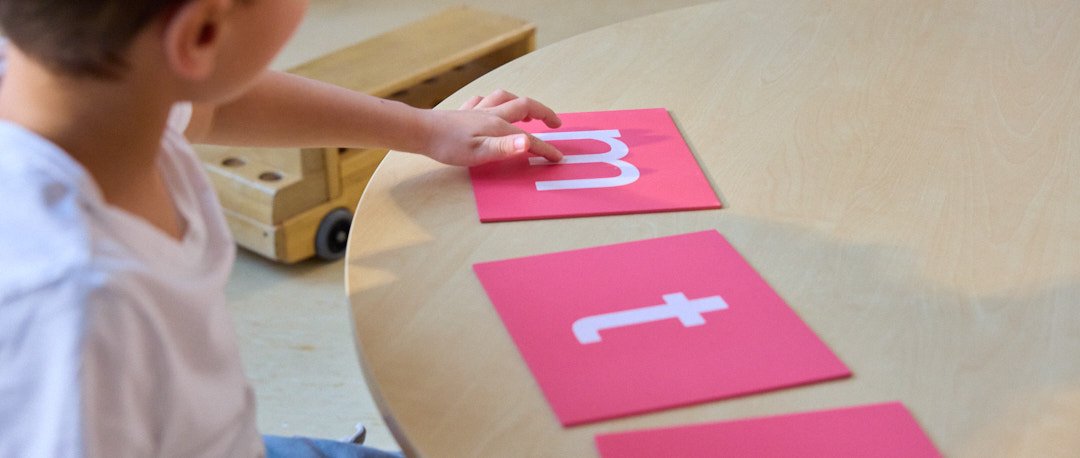
We introduce the children to numbers & letters indirectly through everyday activities. The letters of the alphabet are taught phonetically using a wide range of specially designed materials, as are numbers and early mathematics. Later, as the children begin to read and write, we combine our Montessori education with the National Curriculum for the Foundation stage, aiming for all children to have reached and usually far exceed the required levels in Literacy, Reading and Numeracy expected in their reception year.
To provide a range of multi-cultural activities to enhance the child’s perception of the world and all who live in it, we use real life pictures of people, places and costumes from around the world.
We provide the children with creative activities to enhance their awareness of various festivals celebrated throughout the year. Children are introduced to Geography through the use of globes, puzzle maps and an introduction to flags from around the world.
The foundation aims of the Montessori method of education and the fundamental aims of Under the Willow are to sow the seeds of interest that will fuel learning, giving children education for life. The welfare of the child is paramount. We want to provide a loving, safe and homely environment where the children can follow their ‘inner teacher’ and develop at their own pace at a time when their mind is at its most absorbent. Our carefully trained and caring teaching staff team will help to ensure that this can be facilitated.
Core Principles of Montessori Education
At the heart of Montessori education are principles that respect children as capable, curious, and naturally driven to learn. These ideas guide every aspect of the classroom – from the layout of the environment to the way adults interact with children.
The Prepared Environment
Montessori classrooms are designed to be calm, orderly, and accessible. Child-sized furniture, open shelving, and carefully chosen materials invite children to explore independently. Nothing is accidental: every element has a purpose, whether it’s helping a toddler practise pouring water without spilling, or encouraging a preschooler to explore the concept of numbers with golden beads.
Freedom Within Limits
Children in Montessori settings are free to choose their own activities, but this freedom is not unlimited. Clear ground rules – such as respecting others and caring for materials – create a sense of responsibility. Within these boundaries, children can explore at their own pace, follow their interests, and develop independence.
Hands-On Learning
Instead of sitting passively and listening, children learn by doing. Montessori materials are specifically designed to be tactile and self-correcting. A child working with a puzzle, for example, will notice immediately if a piece doesn’t fit – they don’t need an adult to tell them. This builds problem-solving skills and intrinsic motivation.
Respect for the Child
Perhaps the most revolutionary aspect of Montessori is its respect for children as individuals. Montessori educators observe each child closely to understand their needs, rather than imposing a rigid timetable. Children are encouraged to make choices, express themselves, and take pride in their achievements.
The Teacher as Guide
Montessori teachers are often called “guides.” Their role is not to lecture but to introduce materials, demonstrate their use, and then step back so children can explore independently. They observe, support, and intervene only when needed, allowing the child’s natural curiosity to lead the way.
Together, these principles create an environment where children become self-motivated learners – independent, confident, and deeply engaged.
The EYFS Curriculum
We also follow The Early Years Foundation Framework which is broken down into seven areas oflearning and development:
Personal, Social and Emotional Development
• Shares and takes turns.
• Enjoys the company of friends.
• Learns to behave responsibly.
• Learns to deal with their emotions and feelings.
• Children are provided with experiences and support that will help them to develop a positive senseof themselves and of others; respect for others; social skills; and a positive disposition to learn. Wetake into account children’s emotional well being to help them to know themselves and what theycan do.
Physical Development
• Joins in withactivities using their large muscles e.g. running, jumping, climbing etc.
• Enjoys small muscle activities such as drawing, cutting, painting etc.
• Learns about their health and safety.
• Draws lines and circles using gross motor skills
• Clearly communicates their need for potty or toilet
Communication and Language
• Uses non-verbal or verbal language to communicate with others.
• Listening to stories with increasing attention and recall.
• Beginning to understand ‘why’ and ‘how’ questions.
• Beginning to use more complex sentences to link thoughts.
• Uses language as a powerful means of widening contacts.
Literacy
• Enjoys books and making up stories.
• Begins to link sounds and letters.
• Makes marks and starts to give them meaning.
• Children are helped to understand that written symbols carry meaning, to be aware of the purposes of writing and, when they are ready, to use drawn and written symbols for themselves.
• A well-stocked book corner gives every child the opportunity and encouragement to become familiar with books and aware of their uses, both for reference and as a source of stories and pictures.
Expressive Arts and Design
• Uses simple tools and techniques competently and appropriately
• Creates movement in response to music
• Uses available resources to creates props to support role play
• Plays cooperatively as part of a group to develop and act out a narrative
• Begins to use representation to communicate e.g. drawing a line and saying that me.
Mathematics
• Joins in with singing number songs and rhymes
• Explores patterns and shapes in play
• Uses measures, for example when cooking or in water play
• Enjoys solving real life problems such as jigsaws, matching games and puzzles
• Through practical activities, children become familiar with the sorting, matching, ordering, sequencing and counting skills that form the basis for early mathematics. As they use their developing mathematicalunderstanding to solve problems, children are assisted to learn and use the vocabulary of mathematics,identifying objects by shape, position, size, volume and number. Songs, games and picture books helpchildren become aware of number sequences and, when they are ready, to use simple mathematical operationssuch as adding.
Understanding of the World
• Finds out about the world
• Uses ICT – computers, telephones, etc.
• Develops an understanding of passing time and their place in the world.
• Enjoys and participates in a range of cultural activities
• Children explore and experiment with a range of natural and manufactured materials. They learn to observe the features of objects and substances, recognising differences, patterns and similarities, and to share andrecord their findings.